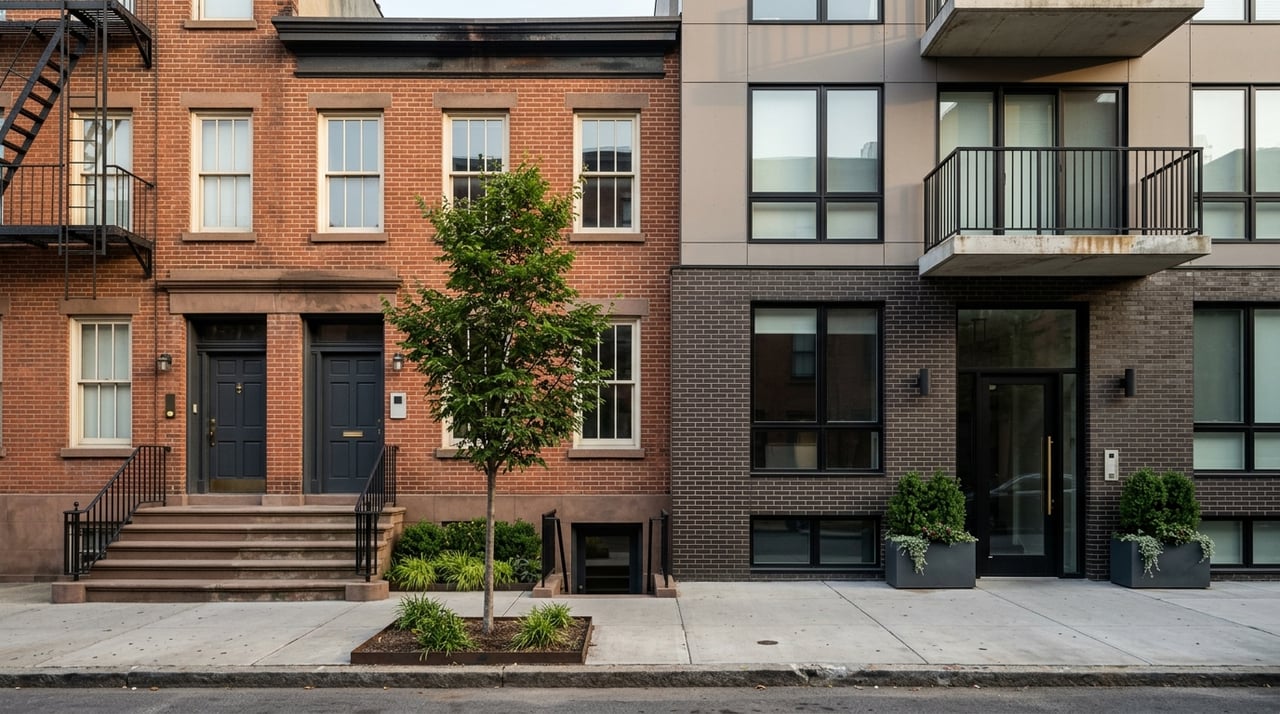
If you are looking at Greenpoint for a long-term investment, the big question is not just what can you afford. It is which asset fits the way you want to own real estate over time. In this market, condos and two-families can both make sense, but they come with very different trade-offs in control, workload, and cost structure. Let’s break down how each option works in Greenpoint so you can compare them with a clear head.
Greenpoint Market Context
Greenpoint continues to show strong demand from both buyers and renters. Realtor.com’s April 2026 snapshot reports 83 homes for sale, 224 homes for rent, a median listing price of $1.635 million, a median sold price of $2.01 million, a median rent of $4,768 per month, and a median of 30 days on market.
Over the past three years, that same source shows notable growth in Greenpoint pricing and rents. Median listing price rose 29.76%, median sold price rose 61.61%, and median rent rose 10.88%. For a long-term investor, that points to a neighborhood with sustained attention and durable demand.
It is also important to know that market portals do not always show the same headline numbers. StreetEasy currently shows a median sale price of $1.1 million and a median base rent of $3,495, which is lower than Realtor.com’s figures. That difference is a good reminder to treat market data as directional and compare methodology before underwriting a deal.
Condos vs Two-Families at a Glance
At a high level, Greenpoint condos tend to be the more convenient and inventory-rich option. Greenpoint two-families tend to offer more direct control, but they usually ask more from you as the owner.
StreetEasy’s current Greenpoint pages show 53 condos for sale and 12 multi-family properties for sale. That does not guarantee easier resale, but it does suggest that condos are currently more available to source and easier to benchmark against comparable listings.
Here is the simplest way to think about it:
| Asset Type | Typical Appeal | Main Trade-Off |
|---|---|---|
| Condo | Lower-touch ownership, simpler unit-level ownership, deeper current inventory | Common charges, board rules, possible assessments |
| Two-family | More control, two potential rent streams, direct management of the asset | More hands-on operations, more repair responsibility, thinner inventory |
Entry Price and Rent Planning
If you are comparing purchase options, current listing examples show a wide pricing range. StreetEasy currently shows Greenpoint condo listings from an $835,000 studio at 29 Huron Street to a $3.95 million four-bedroom unit at 155 Noble Street.
For two-families, examples include 48 Hausman Street at $1.899 million, 27 Van Dam Street at $2.295 million, and 704 Humboldt Street at $2.5 million. These are active listings, not market medians, but they help illustrate that a condo may offer a lower point of entry depending on unit size and building.
When it comes to rental income, the label on the property matters less than the number of legal units and bedrooms. A condo usually produces one rent stream. A two-family can produce two.
Apartments.com reports current Greenpoint average rents of $3,474 for studios, $4,455 for one-bedrooms, $6,186 for two-bedrooms, and $10,312 for three-bedrooms as of May 2026. Those figures are useful as planning benchmarks, but your actual underwriting should focus on the specific unit mix, legal setup, and market position of the property you are evaluating.
Why Condos Appeal to Long-Term Investors
A condo can be a strong fit if you want exposure to Greenpoint without taking on full-building operations. The building structure is more centralized, and many maintenance responsibilities are shared through common charges rather than handled solely by you.
That setup can feel simpler, especially if you value predictability and easier day-to-day ownership. It can also help if you prefer an asset that is easier to compare against other similar listings in the market.
Greenpoint’s current condo inventory is also much deeper than its multi-family inventory. If you want more choices on entry, or if you are thinking ahead to eventual resale, that depth may matter.
Still, a condo is not hands-off. You need to account for monthly common charges, board oversight, and the possibility of special assessments.
The New York Attorney General’s condo guidance makes clear that offering plans should explain common-charge procedures, reserves, repairs, insurance, and occupancy or use restrictions. It also notes that unpaid common charges can result in a lien against the unit, which is one reason detailed review matters before you buy.
Another key point for investors in New York City is the co-op and condo tax abatement. The Department of Finance says that benefit is tied to primary residence use, and the owner must use the unit as a primary residence and not own more than three residential units in one development. For a pure rental investor, that means you generally should not underwrite a condo assuming that abatement will offset your ongoing costs.
Why Two-Families Appeal to Long-Term Investors
A two-family can make sense if you want more control over the asset and are comfortable with active ownership. You are not relying on a condo board to make building decisions, approve budgets, or manage repairs.
That can create more flexibility, especially if you value direct decision-making. It can also mean two rent streams instead of one, depending on the legal setup of the property.
But more control does not mean less responsibility. In practice, it usually means the opposite.
New York City guidance makes clear that property owners and landlords are responsible for keeping buildings safe, clean, and well maintained. Owners are also responsible for essential services such as heat and hot water and for complying with the Housing Maintenance Code and Multiple Dwelling Law.
For a long-term investor, that means a two-family is generally the more management-intensive choice. If something breaks, if a system needs updating, or if tenant-service issues come up, those responsibilities land more directly on you.
Property Taxes Are Not a Shortcut Answer
Many investors want a quick rule on taxes, but in New York City, building type alone does not tell the whole story. According to city guidance, Class 1 generally includes one-, two-, and three-family homes and some small condos, while Class 2 covers primarily residential property with four or more units and condo or co-op buildings that are four stories or higher.
For tax year 2026, the official rates were 19.843% for Class 1 and 12.439% for Class 2. That sounds straightforward, but assessed-value rules differ by class, which means you should compare actual tax bills rather than assume one property type is automatically cheaper to carry.
This is one of the most important practical underwriting lessons in Greenpoint. A condo may have common charges but a different tax structure. A two-family may avoid common charges but carry a different tax bill and more direct building expenses. You need the full ownership-cost picture, not a shortcut.
Rent Regulation Needs Building-Level Review
In Greenpoint, you should not assume that a condo, a two-family, or a newer building is automatically market-rate. Rent regulation is building-specific and sometimes unit-specific.
New York State Homes and Community Renewal says rent stabilization in New York City generally applies to buildings with six or more units built between February 1, 1947 and December 31, 1973, pre-1947 apartments occupied after June 30, 1971, and some newer buildings that received special tax benefits.
That means the right approach is verification, not assumption. If you are considering any income-producing property, review rent status apartment by apartment before you make projections.
How to Choose the Better Fit
If your goal is lower-touch ownership, a condo is usually the cleaner fit. You will likely have more choices in the current Greenpoint market, and the ownership structure is often easier to understand at the unit level.
If your goal is control and you are comfortable operating a rental property, a two-family may be more compelling. You take on more direct responsibility, but you also have more direct influence over how the property is run.
A useful way to frame the decision is this: condos are typically the more convenience-oriented play, while two-families are typically the more control-oriented play. Neither is universally better. The better option depends on how you want to spend your time, manage risk, and hold the asset over the long term.
Due Diligence That Matters Most
For a condo, spend extra time on the building, not just the unit. The New York Attorney General specifically recommends reviewing the full offering plan, board minutes, and the most recent financial report.
Those documents often reveal the real condition of the building, upcoming capital needs, reserve strength, and whether common charges may rise. In Greenpoint, that can be especially important in newer developments and converted buildings.
For a two-family, focus closely on physical condition and ownership obligations. Building systems, deferred maintenance, repair needs, and landlord responsibilities deserve extra attention because there is no broader condo structure absorbing those responsibilities for you.
The simplest takeaway is this: the asset with fewer layers of governance is usually the asset with more responsibility resting directly on the owner.
If you are weighing a Greenpoint condo against a two-family, the smartest move is to compare the real monthly carry, legal rent setup, tax bill, and management burden side by side. If you want a steady, informed read on NYC investment property trade-offs, Cody Parker Hellberg- offers the kind of clear, high-touch guidance that helps you make a more confident long-term decision.
FAQs
What is the main difference between a Greenpoint condo and a Greenpoint two-family for investors?
- A condo is usually a lower-touch, single-unit investment with common charges and board oversight, while a two-family usually offers more direct control and potentially two rent streams but requires more hands-on management.
Are Greenpoint condos easier to find than Greenpoint two-families?
- Current StreetEasy inventory shows more condos for sale than multi-family properties in Greenpoint, which suggests buyers may have more condo options to choose from in the current market.
Do Greenpoint condos qualify for the NYC condo tax abatement if used as rentals?
- The NYC Department of Finance ties the co-op and condo tax abatement to primary residence use, so a pure rental investor generally should not count on that benefit.
Are Greenpoint two-families always better for rental income?
- Not necessarily. A two-family can offer two rent streams, but income depends on the legal unit setup, bedroom count, rent status, operating costs, and building condition.
Should you assume a Greenpoint investment property is market-rate?
- No. In New York City, rent regulation depends on the building and sometimes the specific apartment, so rent status should be verified before you underwrite income.
What should you review before buying a Greenpoint condo as an investor?
- Focus on the offering plan, board minutes, financial reports, common charges, reserves, repair history, and any rules that may affect ownership costs or use.
What should you review before buying a Greenpoint two-family as an investor?
- Focus on building condition, repair needs, essential-service obligations, tenant setup, and the full scope of owner responsibilities for safe operation and maintenance.